From fission heat to electricity: the steps in between
Fission, heat conduction, convection, steam, turbine and generator: a step-by-step account of how a nuclear power station turns nuclear energy into electricity.
A nuclear power station is a heat engine with a nuclear heat source. Following energy from the fuel to the grid shows how reactor physics connects with the familiar work of moving heat, turning a turbine and generating electricity.
What happens during fission?
Fission is the division of a heavy nucleus into two lighter nuclei. In most power reactors the key nucleus is uranium-235. When it absorbs a slow neutron, it forms an excited uranium-236 nucleus that deforms and splits, usually into two fragments of unequal mass, such as isotopes of barium and krypton or of xenon and strontium. Two or three free neutrons emerge at the same moment.
The products have slightly less total mass than the uranium nucleus and neutron that formed them. That missing mass appears as energy, following Einstein's relation E = mc². Each fission releases roughly 200 million electron-volts (MeV). Most of it, around 165 to 170 MeV, appears as the kinetic energy of the two fragments. The remainder is shared among prompt neutrons, prompt gamma rays, and the later radioactive decay of the fission products, which emit beta particles, gamma rays and neutrinos.
For comparison, burning a single carbon atom in oxygen releases about 4 electron-volts. A fission event therefore carries about fifty million times more energy than a typical chemical reaction, which is why a small mass of nuclear fuel can power a city for months.
How does a chain reaction stay steady?
The neutrons released by one fission can cause further fissions. Engineers describe the balance with the effective multiplication factor, written keff: the number of neutrons in one generation divided by the number in the previous generation. When keff equals exactly one, every fission leads on average to one more fission and the power level holds steady. This state is called criticality. A value slightly above one raises the power; a value slightly below one lowers it.
Fresh fission neutrons are fast, carrying about 2 MeV of energy. Uranium-235 captures slow neutrons far more readily, so most power reactors contain a moderator, a light material that slows neutrons through repeated collisions. Ordinary water, heavy water and graphite are the common moderators. After slowing down, neutrons reach thermal energies of a fraction of an electron-volt, where they cause fission efficiently.
Control depends on a small but vital fraction of neutrons. About 0.65 percent of the neutrons from uranium-235 fission are delayed: they come from the decay of certain fission products seconds after the fission itself. These delayed neutrons stretch the effective time between generations from fractions of a millisecond to around a tenth of a second, which gives control systems ample time to respond.
The control systems themselves adjust how many neutrons are absorbed. Control rods made of strong absorbers such as boron carbide or silver-indium-cadmium alloy move in and out of the core. Pressurised water reactors also dissolve boric acid in the coolant and change its concentration slowly over the fuel cycle. Every adjustment shifts keff and with it the reactor power.
How does fission energy become heat?
The two fission fragments leave the split nucleus at high speed and travel only a few micrometres through the fuel before stopping. Along that short path they collide with surrounding atoms and transfer their kinetic energy to the crystal lattice. That vibrational energy is heat. The process happens inside the fuel itself, so the fuel is the hottest part of the reactor.
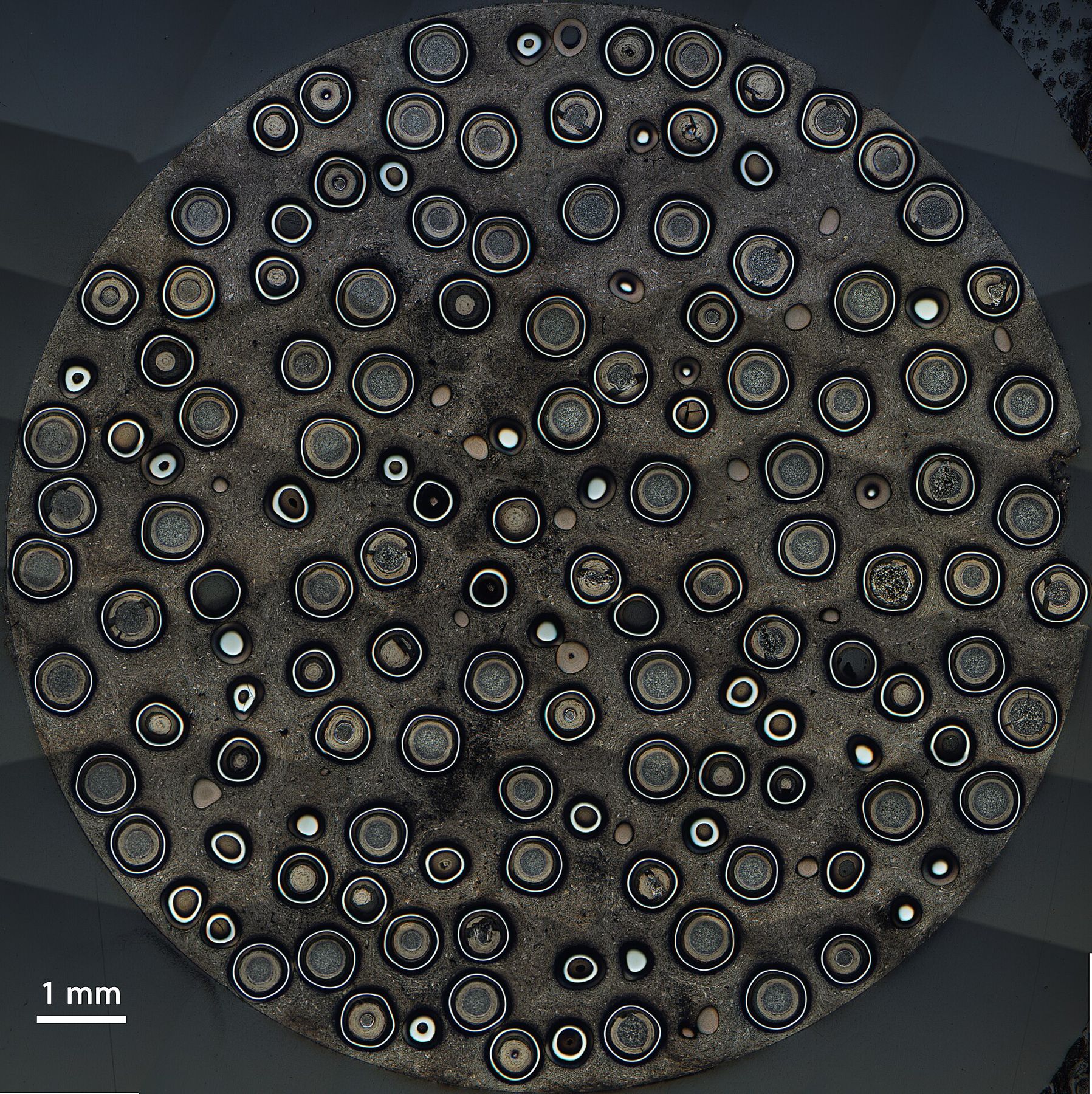
In light-water reactors the fuel takes the form of uranium dioxide pellets about a centimetre across, stacked inside long tubes of zirconium alloy called cladding. Hundreds of these fuel rods are grouped into assemblies, and the assemblies together form the core. Uranium dioxide conducts heat poorly, so a steep temperature gradient develops across each pellet. The centre of a pellet in normal operation sits well above 1,000 °C, while its surface stays a few hundred degrees cooler.
Heat then crosses a thin gap between pellet and cladding, passes through the cladding wall, and enters the coolant. Each of these layers adds thermal resistance. Fuel designers track the temperature at every interface because each material has its own limits: the fuel's melting point, the cladding's strength and corrosion behaviour, and the coolant's boiling conditions.
How does the coolant carry heat out of the core?
The coolant flows upward past the fuel rods and absorbs heat by forced convection. Its temperature rises as it travels through the core, and its flow rate determines how large that rise is. A higher flow carries more heat per degree of temperature rise.
Different reactor types handle the coolant in different ways. In a pressurised water reactor (PWR), the primary water is held at about 15.5 megapascals, roughly 155 times atmospheric pressure, which keeps it liquid at around 300 °C. This hot primary water flows to a steam generator, a large heat exchanger in which thousands of tubes carry primary water while secondary water outside the tubes boils. The two circuits stay separate, so the steam reaching the turbine carries very little radioactivity.
In a boiling water reactor (BWR), the coolant boils inside the reactor vessel at about 7 megapascals, and the steam travels directly to the turbine. This design removes the steam generator and simplifies the plant, while placing the turbine within the radiation-controlled area.
Pressurised heavy-water reactors use heavy water as both moderator and coolant, with fuel held in horizontal pressure tubes. Other designs use helium gas, liquid sodium or molten salt. Each coolant brings its own operating temperature and pressure, and the downstream power-conversion system adapts to it.
How does steam turn into motion?
Steam leaves the steam generator or reactor vessel at high pressure and enters the turbine. Inside, rows of fixed nozzles alternate with rows of moving blades attached to a shaft. Each nozzle row accelerates the steam, and each blade row converts the steam's momentum into torque on the shaft. Steam expands progressively, first through a high-pressure turbine and then through several large low-pressure turbines, giving up energy at every stage.
Between stages, moisture separator reheaters dry the steam, because water droplets erode turbine blades. At the turbine exit, the steam enters a condenser, a large heat exchanger cooled by water from a river, the sea or a cooling tower. The steam condenses at low pressure, which maximises the pressure drop across the turbine and therefore the work extracted. Pumps then return the condensed water to the steam generator to repeat the cycle. Engineers call this closed loop the Rankine cycle.
How does the generator produce electricity?
The turbine shaft drives an electrical generator. The rotating part of the generator, called the rotor, carries electromagnets energised by direct current. As the rotor turns, its magnetic field sweeps past heavy copper windings in the stationary part, the stator. The changing magnetic flux induces an alternating voltage in those windings, following Faraday's law of induction.
The generator turns at a speed set by the grid frequency. On a 50-hertz grid, a two-pole generator turns at 3,000 revolutions per minute and a four-pole generator at 1,500. Many large nuclear turbine-generators use the four-pole arrangement. A step-up transformer then raises the voltage for transmission.
Why is the electrical output smaller than the reactor's heat?
Every heat engine converts only part of its heat input into work. The upper limit is set by the Carnot efficiency, 1 − Tcold/Thot, with temperatures measured in kelvin. A water-cooled reactor delivers steam at a little under 300 °C (about 560 K), and the condenser rejects heat near 30 °C (about 300 K). The Carnot limit for those temperatures is roughly 46 percent. Real plants lose additional energy to friction, turbulence, heat losses and the moisture in steam, and typical water-cooled stations achieve a net efficiency of about 33 percent.
Station equipment also consumes part of the output. Reactor coolant pumps, feedwater pumps, cooling-tower fans and control systems all draw electricity. The figure sent to the grid is the gross generator output minus this internal load.
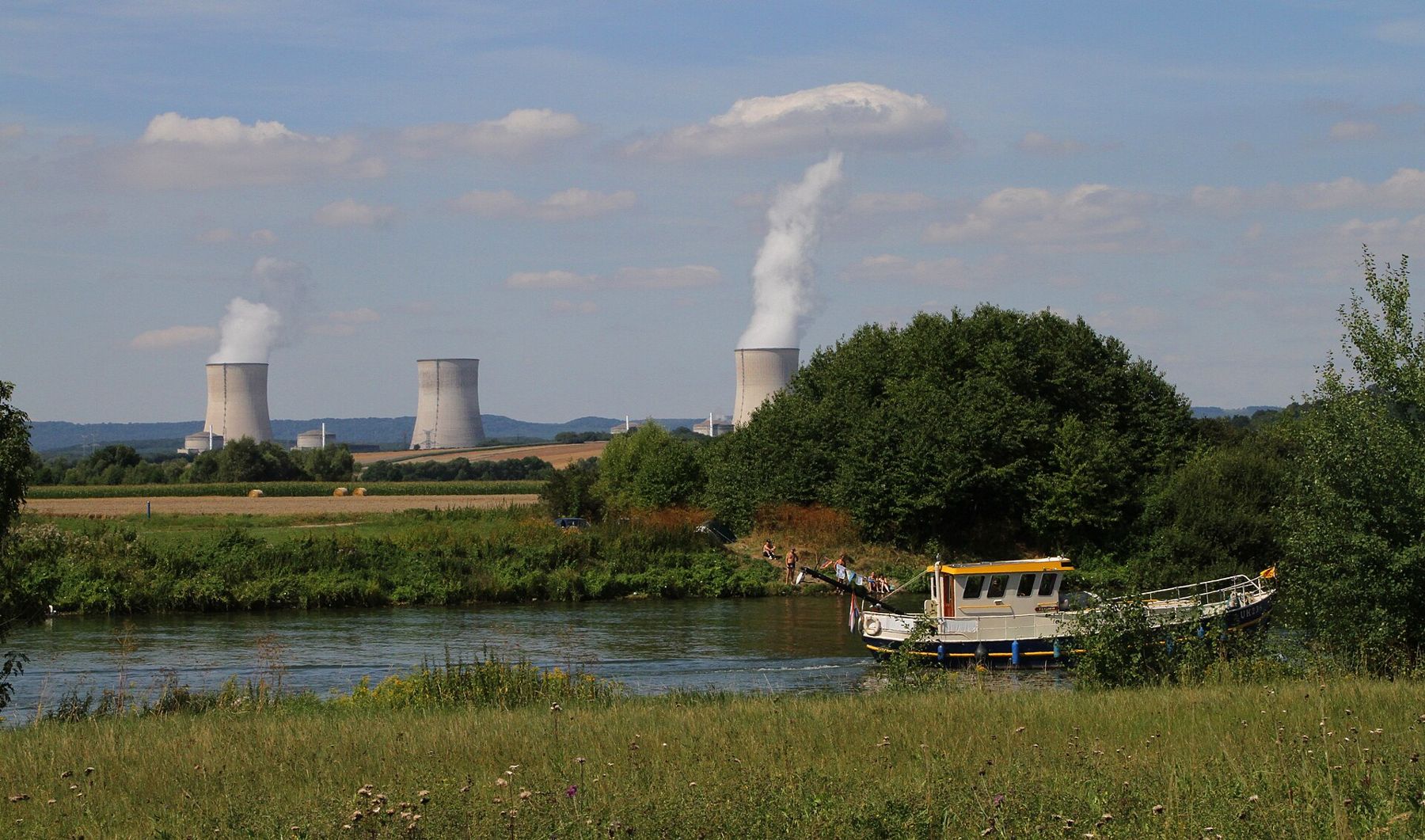
The remaining heat, around two-thirds of the reactor's thermal power, leaves the plant through the condenser. Cooling towers transfer it to the air, partly by evaporating water. The white plume above a cooling tower is condensed water vapour.
Higher coolant temperature raises the thermodynamic ceiling. This is one reason high-temperature reactor designs, with outlet temperatures of 750 °C and above, draw interest for both electricity and industrial heat.
What happens to the heat after shutdown?
Inserting the control rods stops the chain reaction within seconds, while the radioactive fission products in the fuel continue to decay and release energy. This decay heat amounts to about 6 to 7 percent of full power immediately after shutdown and falls to around 1 percent within a few hours. For a large reactor, even 1 percent equals tens of megawatts, so cooling systems must keep running long after shutdown. Safety system design centres on removing this heat reliably under every credible condition.
Which quantities do designers track along the chain?
The energy path links several quantities that depend on each other:
- Neutron flux and power distribution. The neutron flux determines where fission occurs, and therefore where heat is generated. Power usually peaks near the centre of the core and falls toward the edges.
- Fuel and cladding temperatures. These set material limits and affect neutron behaviour, because hotter fuel absorbs more neutrons in uranium-238 through Doppler broadening, which lowers reactivity.
- Coolant flow and temperature rise. Flow conditions shape how temperature builds up along each channel and how close the coolant comes to boiling limits.
- Steam conditions. Steam pressure and temperature at the turbine inlet, together with condenser conditions, fix the cycle efficiency.
- Station load. Pump and auxiliary power determine the net electricity delivered.
These quantities interact. A change in coolant temperature alters the moderator density, which alters the neutron flux, which alters the power distribution, which alters the coolant temperature again. A calculation of the core alone describes one part of the plant; a credible estimate of electrical output requires the core, the thermal-hydraulic systems and the power-conversion cycle working together.