TRISO fuel: what high-temperature tests have measured
The structure, manufacture and testing of coated-particle fuel, including the AGR-1 furnace tests at 1,600 °C and 1,800 °C.
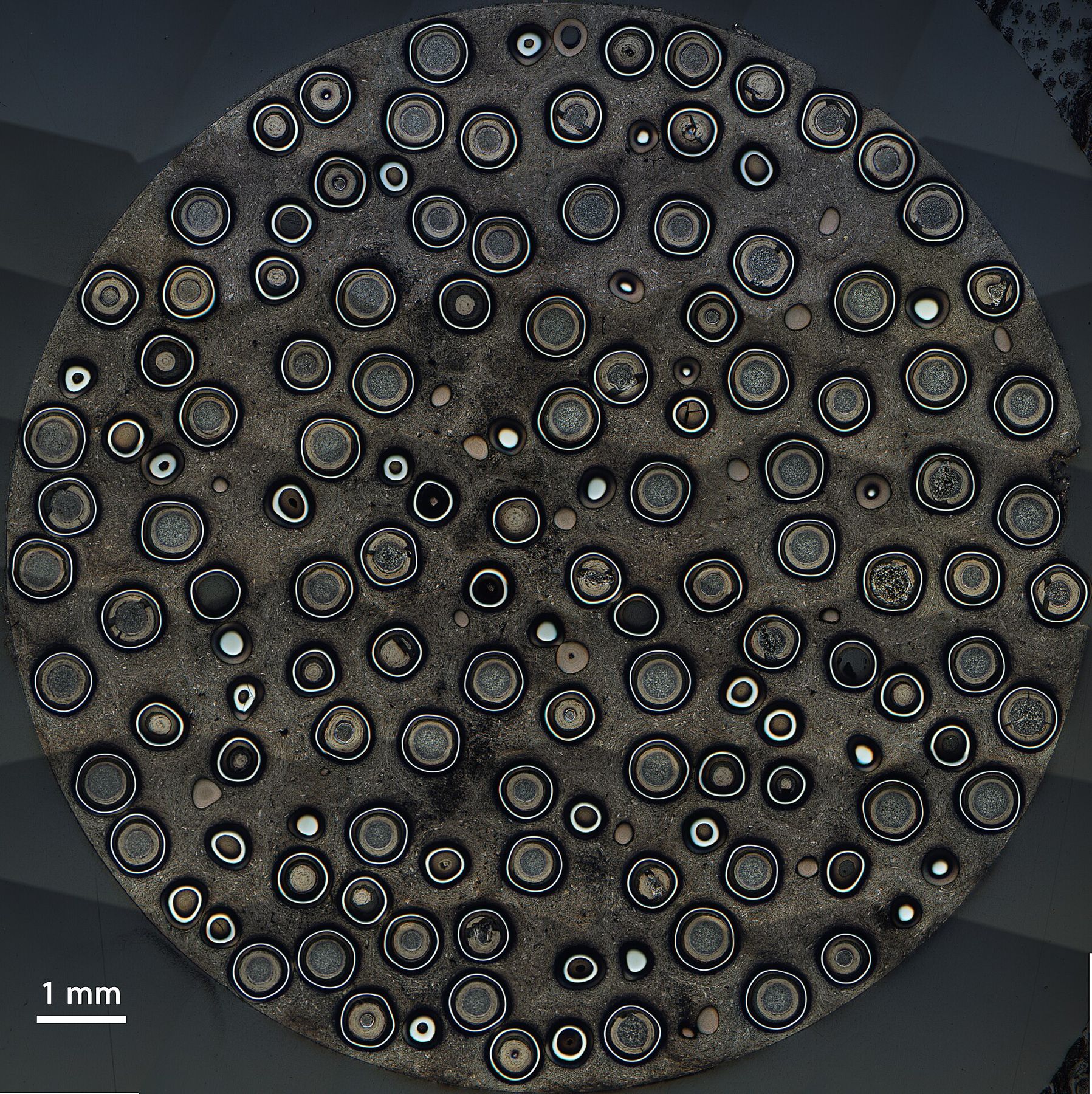
TRISO fuel holds uranium or thorium kernels inside multiple carbon and ceramic coatings. Each particle is smaller than a millimetre, yet its layers perform several jobs: they accommodate fission gases, support the kernel and retain many fission products. AGR-1 irradiation and furnace tests provide detailed evidence about how one U.S. fuel design performs.
What is TRISO fuel?
TRISO stands for tri-structural isotropic. The name refers to three structural materials in the coating (porous carbon, dense pyrolytic carbon and silicon carbide) and to the uniform, direction-independent character of the layers. Coated-particle fuel was developed in the United Kingdom and Germany in the late 1950s and 1960s for gas-cooled reactors, and the TRISO design, with its silicon carbide layer, became the standard form.
A single TRISO particle is just under a millimetre across, about the size of a poppy seed. Tens of thousands of particles go into each fuel element, and a reactor core holds billions of them.
What are the layers, and what does each one do?
A TRISO particle consists of a fuel kernel surrounded by four coating layers. In the U.S. Advanced Gas Reactor (AGR) programme, the particles had these parts, listed from the centre outward:
- Fuel kernel. A sphere of uranium oxycarbide (UCO) about 350 micrometres in diameter in the AGR particles. Fission takes place here. Kernels can also be made of uranium dioxide or thorium-bearing oxides.
- Porous carbon buffer. A low-density carbon layer about 100 micrometres thick. It provides empty volume for gaseous fission products such as xenon and krypton, absorbs fission fragments that recoil out of the kernel, and accommodates swelling of the kernel.
- Inner pyrolytic carbon (IPyC). A dense, gas-tight carbon layer about 40 micrometres thick. It protects the kernel from the chlorine compounds used when the next layer is deposited, retains gaseous fission products, and provides a smooth surface for that layer.
- Silicon carbide (SiC). A hard ceramic layer about 35 micrometres thick. It acts as the main pressure vessel of the particle and the principal barrier to metallic fission products such as caesium and strontium.
- Outer pyrolytic carbon (OPyC). A final dense carbon layer about 40 micrometres thick. It protects the silicon carbide during handling and bonds the particle to the surrounding graphite matrix.
The pyrolytic carbon layers shrink under neutron irradiation while the silicon carbide stays dimensionally stable. This shrinkage places the silicon carbide in compression, which helps it resist the internal gas pressure that builds up as fission proceeds.
How are TRISO particles made?
Kernel production usually follows a sol-gel route. A solution containing uranium is formed into droplets that gel into small spheres, which are then washed, dried and heated to form dense ceramic kernels of very uniform size.
The coatings are applied by fluidised-bed chemical vapour deposition. Kernels are placed in a vertical furnace and suspended by an upward flow of gas, so they tumble freely. At high temperature, precursor gases decompose on the particle surfaces and deposit solid layers. Acetylene and propylene produce the carbon layers, and methyltrichlorosilane produces silicon carbide. Controlling the gas mix, temperature and time sets the thickness and density of each layer. Modern processes deposit all four layers in one continuous run.
Quality control measures layer thicknesses, densities and the fraction of particles with defective coatings, often by leaching tests that detect exposed uranium. Manufacturing consistency is central to TRISO performance, because the safety case relies on the statistics of billions of particles.
How are particles assembled into reactor fuel?
Particles are mixed with graphite powder and a binder and formed into one of two fuel types.
Pebbles are spheres about 6 centimetres across, slightly smaller than a tennis ball. Each holds thousands of particles in a central fuel zone surrounded by a fuel-free graphite shell. Pebble-bed reactors contain hundreds of thousands of these spheres, which move slowly down through the core and can be reloaded while the reactor operates. China's HTR-PM, a pebble-bed demonstration plant, entered commercial operation in 2023.
Compacts are small cylinders, about 12 millimetres across and 25 millimetres long in the AGR programme. They are stacked inside holes in hexagonal graphite blocks, which form a prismatic core with separate channels for helium coolant.
In both cases the graphite acts as moderator, structural material and heat conductor, and helium carries heat away from the fuel.
How was the AGR-1 fuel tested?
The U.S. Advanced Gas Reactor Fuel Development and Qualification Program set out to establish the performance of UCO TRISO fuel through irradiation and safety testing. Its first experiment, AGR-1, irradiated fuel compacts in Idaho National Laboratory's Advanced Test Reactor. The compacts reached burnups approaching 20 percent of the initial heavy-metal atoms, a high value for any fuel. Post-irradiation examination reported excellent particle performance, with very low numbers of failed particles during irradiation.
After irradiation, selected compacts were heated in a dedicated furnace, the Fuel Accident Condition Simulator (FACS), to temperatures representative of, and beyond, those expected in a severe loss-of-cooling event. Instruments collected the fission products released during heating, and the particles were inspected afterwards to relate releases to coating condition.
What did the high-temperature tests measure?
Demkowicz and colleagues reported tests at 1,600 °C and 1,800 °C, including holds lasting hundreds of hours. In the tested compacts, the fraction of caesium released from particles with intact coatings remained below 10−6 after 300 hours at 1,600 °C and after 100 hours at 1,800 °C. Expressed simply, less than one part in a million of the caesium inventory escaped from intact particles.
The tests also recorded element-specific behaviour, which reveals how each fission product interacts with the coatings:
- Silver diffuses through intact silicon carbide at irradiation temperatures and showed the highest releases.
- Caesium stayed well retained by intact silicon carbide; measurable caesium release pointed to particles whose silicon carbide had failed.
- Strontium and europium showed partial release through intact coatings at the highest temperatures.
- Krypton, a noble gas, served as an indicator of particles in which all the dense layers had failed.
Some silicon carbide failures occurred during the tests, and their causes were investigated. Mechanisms studied in TRISO fuel include localised attack on silicon carbide by palladium and other fission products, thermal decomposition of silicon carbide at very high temperatures, and pressure-driven failure.
These findings describe the AGR-1 fuel, its irradiation history, the compact samples and the specific furnace tests in the study.
How do these results feed into fuel qualification?
Test results like these provide evidence for fuel performance models and for safety analysis. Fuel qualification draws on a wider body of evidence: manufacturing specifications and controls, irradiation experiments covering the intended operating range, post-irradiation examination, safety testing, and models that tie these together. Later experiments in the same programme, such as AGR-2 and AGR-3/4, extended the database to other fuel variants and to the study of fission-product transport through graphite.
Why is TRISO fuel challenging to simulate?
TRISO fuel poses a distinctive problem for reactor physics, known as double heterogeneity. Neutrons see structure at two scales: tiny particles randomly scattered through a graphite matrix, and fuel elements arranged within the core. Fuel kernels absorb neutrons strongly at certain energies, so the arrangement of particles affects how many neutrons reach each kernel. Treating the fuel as a uniform mixture overestimates resonance absorption and gives a different answer from a model that keeps the particles separate.
Modellers use several approaches:
- Explicit models place every particle in the geometry. Monte Carlo codes can track neutrons through millions of particles, preserving local structure at high computing cost.
- Homogenised models smear the particles and matrix into a uniform material, which is fast and requires corrections for the self-shielding effect.
- Equivalence methods, such as the reactivity-equivalent physical transformation, replace the particle region with a smaller homogeneous zone sized to reproduce the reactivity of the explicit model.
Comparisons between these approaches, together with measured fuel data, show which simplifications are acceptable for a given design question, such as core reactivity, power distribution or fuel temperature.
Sources
- Demkowicz et al., First high temperature safety tests of AGR-1 TRISO fuel with the Fuel Accident Condition Simulator (FACS) furnace, Journal of Nuclear Materials 464 (2015)
- Demkowicz et al., Key results from irradiation and post-irradiation examination of AGR-1 UCO TRISO fuel, Nuclear Engineering and Design 329 (2018)